.png)

Indian Mughal History: A Traveller’s Guide to the Golden Triangle’s Glorious Past
Your essential pre-travel guide to understanding the history, architecture, and stories behind India’s most iconic Golden Triangle monuments.
Travel is not only about seeing places, but it is also about feeling their stories. When you explore the Golden Triangle — Delhi, Agra, and Jaipur — you are stepping into the world of emperors whose personal loves, losses, dreams, alliances, and tragedies shaped the architecture of India.
This guide is written for travellers who want more than sightseeing. It offers stories behind the monuments, making your journey emotional, immersive, and unforgettable.
Why Mughal History Matters for Your Golden Triangle Journey
Most travellers arriving in India for the first time are instantly captivated by the architectural splendour of Delhi, Agra, and Jaipur — the famed Golden Triangle. But what makes this region truly unforgettable is not just the beauty of its monuments; it is the history, power struggles, love stories, and cultural exchanges that shaped them.
This guide is created especially for international travellers preparing for a Golden Triangle Tour. It gives you a simple, engaging overview of Indian Mughal History and the stories linked to the monuments you will actually visit — so when your guide speaks about emperors, dynasties, and architectural styles, you will instantly feel connected and informed.
The Rise of the Mughal Empire: A New Chapter in Indian History
Babur (1526–1530) — The Founder
The Mughal Empire began in 1526, when Babur, a Timurid prince from the Fergana Valley (present-day Uzbekistan), defeated Ibrahim Lodi in the First Battle of Panipat. With this victory, a new dynasty rooted in Persian, Central Asian, and Indian cultural influences was born.
He loved gardens because they reminded him of the valleys of Central Asia — a nostalgia that later inspired India’s finest garden tombs.
From Babur to Aurangzeb, the Mughal dynasty was a blend of:
- Love and heartbreak
- Ambition and betrayal
- Diplomacy and war
- Alliances that shaped India’s cultural future
The Mughals did not just build monuments; they lived dramatic lives that shaped India’s history. You will meet these emperors through the monuments you visit.
The Emperors & Their Emotional Legacies
Here are the key emperors whose stories you’ll encounter on your Golden Triangle Tour — not just as rulers, but as humans with extraordinary lives.
Humayun: The Exiled Emperor Who Found Peace in Love – (1530–1540; 1555–1556)
Humayun lost his kingdom, fled across deserts, and spent years in exile. In these difficult times, his wife Hamida Banu Begum stood by him like a rock — travelling with young infants, protecting him, sharing his hardships. When he returned to the throne, their story became one of resilience and partnership.
After his sudden death, she built Humayun’s Tomb — not just a tomb, but a wife’s tribute to a man she loved deeply. This is why the monument feels so serene and tender.
Akbar: The Emperor Who Dreamed of Harmony (1556–1605)
Akbar was a warrior and a thinker — and his story is filled with emotional depth.
He married Rajput princesses, not as political trophies, but to build bridges between cultures. His alliances were not forced — they became friendships, partnerships, shared artistic visions. His secular philosophy, “Sulh-i-Kul” (Peace with All), shaped India for decades.
Akbar’s emotional legacy is visible in:
- The Hindu–Islamic fusion of Fatehpur Sikri
- The delicate carvings inspired by Rajput styles
- The broad courtyards where he held open dialogues with people of all faiths
He dreamed of a capital that symbolised harmony. That dream became Fatehpur Sikri — his beloved city.
And yet, heartbreak awaited…
It was abandoned due to water scarcity. An emperor’s dream city turned into a silent ghost town. When you walk through its empty halls, you feel the ache of a grand dream without a future.
Jahangir: The Lover of Beauty, Nature & Stories (1605–1627)
If Akbar was philosophy, Jahangir was poetry. He filled his court with artists, travellers, storytellers. Jahangir had a sensitive heart and a keen eye; he wrote about gardens, animals, birds, and love. He passed on this artistic passion to his son…
Shah Jahan: The King Who Loved Too Deeply (1628–1658)
Shah Jahan ruled at the peak of Mughal glory, but his life was shaped by one emotion — love. His wife, Mumtaz Mahal, was not just a queen; she was his confidante, advisor, and closest companion. Their love was gentle, equal, deeply emotional. When she died in childbirth in 1631, the emperor broke down completely. Grief transformed into creation.
That grief became:
- The luminous Taj Mahal
- a symbol of eternal love
- a monument of romantic agony
- a structure built from heartbreak
Later, the same man who built the greatest tomb of love was imprisoned in Agra Fort by his son, Aurangzeb. For eight long years, Shah Jahan sat in his marble chamber, looking at the Taj Mahal across the Yamuna, longing for the woman he loved.
His last sigh was for her. He never left the fort again.
Aurangzeb: (1658–1707) — The Last Major Ruler – The Prince Who Took the Throne with Blood
Aurangzeb’s story is one of tension, ambition, and conflict. He defeated his own brothers, imprisoned his father, and ruled a vast empire. While he expanded Mughal territory, his rise came with emotional darkness — ruptured families, broken loyalties, and a dynasty that began to fracture.
After his death, the empire slowly weakened.
The Mughals gave India some of the world’s most iconic architectural wonders. You will see these firsthand in Delhi and Agra.
Key Features of Mughal Architecture
- Symmetry and geometric precision
- Use of red sandstone and white marble
- Domes, minarets, and jali (lattice) work
- Persian-style gardens (Charbagh)
- Calligraphy and pietra dura (stone inlay)
Delhi: The Mughal Capital in Its Prime — But First, the Delhi They Inherited
Before the Mughals built their grand capitals, Delhi had already lived many lives. It had witnessed dynasties rise and fall, armies march through its gates, and kings carve their names into history. Two iconic landmarks — Qutb Minar and Lodhi Gardens — help you understand this pre-Mughal era.
Together, they form the foundation of the architectural journey that leads to Humayun’s Tomb, the Red Fort, and eventually, the Taj Mahal.
Qutb Minar: The Birthplace of Indo-Islamic Architecture in India

Long before the Mughals, the early Delhi Sultanate dynasties began shaping the architectural identity of northern India. The most spectacular legacy from this era is the Qutb Minar, begun by Qutb-ud-din Aibak in the early 13th century and continued by his successors.
Rising 73 metres into the sky, this minaret marks the arrival of Islamic architecture on Indian soil.
Why Qutb Minar Matters in Your Golden Triangle Context
- It showcases the earliest use of red sandstone, Arabic calligraphy, and geometric motifs — elements that the Mughals later perfected.
- The surrounding complex, including the Quwwat-ul-Islam Mosque, blends Indian craftsmanship with Islamic motifs, symbolising the beginning of a new architectural fusion.
- The towering structure represents Delhi’s layered history — every dynasty added something to the city long before the Mughals arrived.
As you stand below the Qutb Minar, you feel the pulse of a city that was already ancient when the Mughals first entered India. It is the prologue to the story you’re about to experience — the earliest whisper of an architectural style that later becomes the Mughal symphony.
Lodhi Gardens: The Quiet Prelude to Mughal Garden Tombs

A short distance from the bustling streets of Delhi lies the calm, atmospheric world of Lodhi Gardens.
Here rest the domed tombs of the Sayyid and Lodhi dynasties — the rulers who shaped Delhi just before Babur’s arrival and the beginning of Mughal rule.
Why Lodhi Gardens Prepare You for the Mughal Story
- The tombs of Sikandar Lodhi and Muhammad Shah show the early development of Indian Islamic domed architecture.
- For the first time, tombs were set inside landscaped surroundings — a concept that the Mughals later refined into the Charbagh garden style seen at Humayun’s Tomb and the Taj Mahal.
- You can observe the transition phase between simple Sultanate designs and the ornate Mughal masterpieces that followed.
Walking through Lodhi Gardens feels like reading the early chapters of a book whose climax you already know. These structures are the rough sketches of ideas that the Mughals would later transform into breathtaking works of art. They are the bridge between Delhi’s Sultanate past and its Mughal future.

And Then Arrived the Mughals…
After absorbing the pre-Mughal layers of Delhi, you step into the beginning of the Mughal architectural journey.
Delhi: The Mughal Capital in Its Prime: Where Love, Power & Ambition Built a City
Delhi reflects the entire emotional spectrum of the Mughal dynasty before and after.
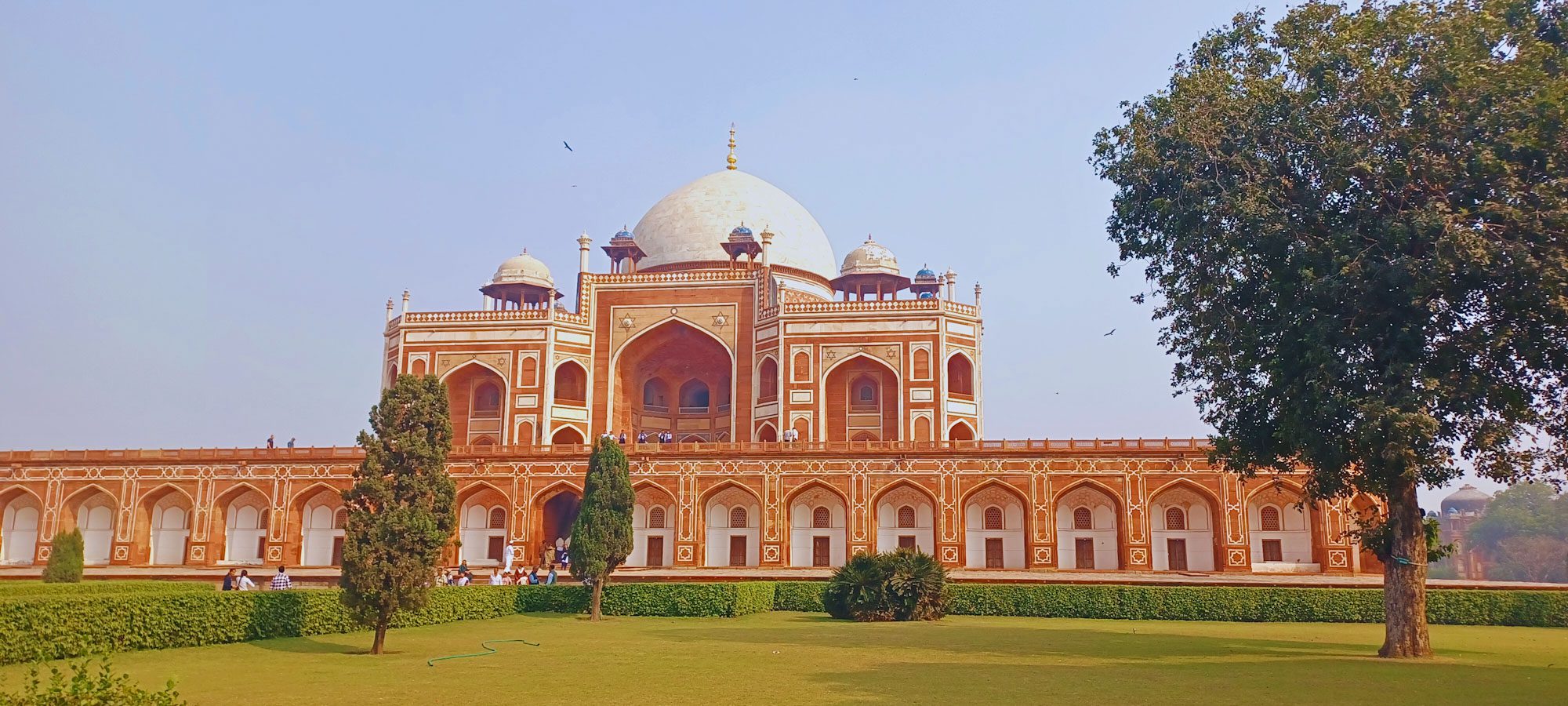
Humayun’s Tomb — A Wife’s Tribute
This tomb is not just architecture. It is love expressed through:
- Built in 1570 by Empress Hamida Banu Begum
- Perfect symmetry
- Persian gardens that evoke paradise
- White marble framed by red sandstone
- Quiet pathways meant for reflection
- First true garden-tomb (Charbagh layout)
- Direct architectural predecessor of the Taj Mahal
- A perfect symbol of the rebirth of the Mughal Empire after Humayun regained his throne
When you walk inside, notice the high arches, symmetrical pathways, and Persian geometry — the beginning of architectural traditions perfected later. When you explore it, you walk through a love story that shaped Mughal architecture forever.

Jama Masjid — Shah Jahan’s Monument of Victory & Devotion
Built at the height of Mughal power, Jama Masjid carries the confidence of an emperor who believed he could shape eternity.
Yet behind the grandeur is a quieter story — the emperor praying for peace after losing his beloved wife.
- Built between 1650 and 1656
- Largest mosque in India
- Constructed by Emperor Shah Jahan, who also built the Taj Mahal
- A masterpiece of red sandstone and marble
The courtyard once held 25,000 worshippers. The mosque symbolises the golden age of Mughal architecture.

Red Fort — A Palace That Once Heard Laughs, Whispers & Tears
Inside these walls:
- Emperors planned wars
- Courtiers schemed
- Princesses painted poetry on marble
- Musicians played during golden evenings
- And later, Shah Jahan mourned alone in captivity
- Built by Shah Jahan in 1648
- Once housed the royal family
- A fortified palace complex with audience halls, gardens, and intricate marble chambers
- The emperor ruled the empire from here
Today, its red sandstone walls stand as a reminder of India’s imperial past and later its independence struggle.
The Red Fort was not just a palace — it was a theatre of human drama.
Agra: The City of Love, Loss & Imperial Grandeur
The city of Taj, Agra, is where the Mughal story becomes deeply personal. Agra was the centre of power for decades under Akbar, Jahangir, and Shah Jahan. It is here that Mughal architecture reached perfection.
The Taj Mahal — Love That Outlived Death
Every stone of the Taj Mahal whispers emotion. You will notice:
- its changing colours (symbolising moods of love)
- its perfect symmetry (reflecting harmony)
- its calligraphy (verses about paradise)
- its fineness (built by hands shaking with grief)
- Built by Shah Jahan in memory of his wife Mumtaz Mahal
- Completed in 1653
- Considered one of the Seven Wonders of the World
- A fusion of Persian, Indian, and Islamic architecture
- Perfect symmetry, reflecting pools, pietra dura, calligraphy, and a luminous white dome
- The monument symbolises devotion, beauty, and the sophistication of the Mughal golden age.
The story is not the Taj Mahal itself — it is why it exists. It is the physical form of a broken heart.
Agra Fort — A Father’s Final Prison
Walk into the fort, and you are walking into:
- royal courts
- private chambers
- mirrored halls
- and the place where Shah Jahan lived his final years
- Built by Akbar in 1565
- Once a military base, it was later transformed into a palace
- Houses beautiful structures like the Muthamman Burj, Diwan-i-Khas, and Diwan-i-Aam
- Shah Jahan spent his final days imprisoned here, gazing at the Taj Mahal across the river
Look toward the small marble balcony facing the Taj…
That is where he sat, day after day, looking at Mumtaz’s tomb, unable to visit her. This makes the fort emotionally heavier than any monument in India.
Fatehpur Sikri & Buland Darwaza — The Abandoned Dream
Built by Akbar as the capital of unity, artistry, and wisdom — yet abandoned within 15 years.
Here you feel:
-
- The echoes of lively courtyards are now silent
- The unfulfilled dreams of an emperor
- a once-bustling palace now frozen in time
- Buland Darwaza, the “Gate of Victory”
- Jama Masjid, Panch Mahal, Diwan-i-Khas, and Jodha Bai’s Palace
- Fusion of Hindu, Persian, and Islamic design
- Abandoned due to water scarcity, but still one of the best-preserved Mughal city complexes in India
The city stands as a reminder that even great emperors are defeated by fate. Just an hour from Agra lies Fatehpur Sikri, Akbar’s once-magnificent capital.
Jaipur: Where Love & Alliances Changed India
Jaipur’s Rajput rulers played a crucial emotional and political role in the Mughal story. Jaipur isn’t a Mughal city, but the relationship between the Mughals and Rajputs is central to understanding your Golden Triangle tour.
The Rajputs were powerful warrior clans. Many formed alliances with the Mughals through diplomacy and marriage — this shaped both architecture and politics. The Mughal–Rajput alliances were not only political:
- They created trust
- They created cultural fusion
- They shaped architecture
- They gave India two of its most influential queens
Rajput princesses brought:
- new rituals
- new aesthetics
- new artistic styles
These elements blended with Persian influence to create a unique Indo-Islamic identity.
Amer Fort — The Palace Where Two Worlds Meet
Amer Fort is not only a Rajput stronghold. It is a canvas of two cultures merging — Rajput valour and Mughal refinement. You will see:
- Hindu motifs influenced by Mughal elegance
- Mirror work inspired by Persian design
- Gardens laid out in Mughal style
- Gateways reminiscent of imperial courts
This fort is the story of India’s most important cultural alliance. Raja Man Singh served in Akbar’s court — hence the cultural exchange you will see here. The Sheesh Mahal (Mirror Palace) is one of its most exquisite attractions.
The fort beautifully combines Rajput defence architecture with Mughal artistic detail.
Your Golden Triangle Tour: A Timeline of Emotions
- Delhi — Ambition & Beginnings: Where emperors dreamt, plotted, prayed, laughed, and ruled.
- Agra — Love & Power: Where the Mughal story found its heart and later its heartbreak.
- Jaipur — Alliances & Harmony: Where partnerships shaped India’s political and cultural future.
Every city is a chapter, every monument is a memory, and every wall has heard stories of passion, power, love, and loss.
Traveller Tips: How to Feel the Story, Not Just See the Place
✔ Ask your guide about the emotions behind each monument
✔ Stand still and observe symmetry — it tells you who built the monument
✔ Look for Rajput-Mughal fusion patterns in Amer Fort
✔ Stand in the observation area of Agra Fort’s balcony and imagine Shah Jahan watching the Taj
✔ Walk through Fatehpur Sikri at sunset — it feels like a dream fading
✔ See Tajmahal bathing in the setting sun — they reveal Shah Jahan’s pain and faith
Why This History Matters For Your Tour
Because knowledge transforms travel. When you know:
- Akbar’s dream
- Shah Jahan’s heartbreak
- Aurangzeb’s ambition
- The Mughal–Rajput marriages
- The abandoned city of Fatehpur Sikri
- The imprisoned emperor’s final view of the Taj Mahal
The Golden Triangle is no longer just sightseeing — it becomes a living story.
Conclusion: When You Visit, Let the Emotions Guide You
When you stand before the Taj Mahal, remember it is not just stone — It is the last heartbeat of a grieving emperor.
As you walk through Fatehpur Sikri, remember it is not just a city — It is the unfulfilled dream of a visionary king.
When you explore Amer Fort, remember it is not just architecture — It is the story of two great cultures coming together.
And when you see Delhi’s monuments, remember — You are standing exactly where history changed forever.
On your Golden Triangle journey, let the monuments speak for themselves. Let the stories guide you. Let the emotions stay with you long after the trip ends.
India’s Golden Triangle is one of the world’s most iconic travel routes, not just for its beauty but for the centuries of history it reveals. For travellers planning their first trip to India, understanding the Mughal era unlocks a deeper appreciation of every monument, every archway, and every story your guide will share. Whether you are exploring Delhi’s royal legacy, admiring Agra’s timeless monuments, or discovering Jaipur’s Rajput grandeur, Mughal history binds it all together.
Plan your Golden Triangle Tour with deeper insight — and experience Indian history come alive in every step you take.
Recent Posts
- Meet Thami: Sherpas—the Face and Backbone of Himalayan Treks
- Indian Mughal History: A Traveller’s Guide to the Golden Triangle’s Glorious Past
- Shaping Curious Minds: Travel With Susmita × Ganit Charcha
- Why Responsible Tourism Matters: True Nomadism Vs Modern Digital-Age Travel
- Why North East India is Asia’s Best-Kept Secret for Culture-Driven Explorers
- Exploring India One City at a Time: Why Kolkata Deserves a Spot on Your Travel Bucket List
- Luxury with a Local Touch: Why Premium Doesn’t Mean Mainstream
- The Chronicles Of Laos – Episode III: Vientiane Travel Guide through the Eyes of a Solo Traveller
- Golden Triangle and Beyond: The Colours and Forts of Jaipur
- Golden Triangle and Beyond: The Timeless Wonders of Agra
Popular Posts
- How to plan a trip to Ladakh
- Monsoon Travel Tips: A Comprehensive Guide with 60 Essential Tips for a Rainy Season Adventure
- From the Silk Road to Scenic Valleys: A Solo Traveller’s Tale in Kazakhstan
- Golden Triangle and Beyond: The Timeless Wonders of Agra
- The Chronicles of Laos – Episode I – Getting Ready
- Golden Triangle and Beyond: The Colours and Forts of Jaipur
- Golden Triangle and Beyond: First Impressions of Delhi
- Why North East India is Asia’s Best-Kept Secret for Culture-Driven Explorers
- Backpacking Europe 2022 | Two Weeks in The Netherlands | Reaching and Exploring Hellevoetsluis
- The Chronicles Of Laos – Episode III: Vientiane Travel Guide through the Eyes of a Solo Traveller